|
The Defense Budget Time Bomb Has Been Outted By the
Congressional Budget Office
January 10, 2003
Comment: #468
Separate Attachments in Adobe Acrobat format:
Atch 1 (718KB PDF) The Long Term Implications of Current Defense Plans, Congressional Budget Office, January 2003
Atch 2 (149KB PDF) Versailles on the Potomac: A quick trip through an American Hall of Mirrors, Franklin C. Spinney, November 2002 (updated in Dec 2002).
The non-partisan Congressional Budget Office (CBO) has stolen and plagiarized the Pentagon's Defense Program Projection (DPP - pronounced "dip") and in so doing has outted the Pentagon's budget time bomb. That this bomb exists is not new news, but the outing of the DPP is important news.
The DPP is now published, with some slight variations, as a publically available CBO Report! To be sure, CBO acknowledges the data came from the Pentagon, but the extent of the theft is not acknowledged. Nevertheless, this is a GOOD theft, if somewhat smarmy in its intellectual pretensions.
In fact, CBO has performed a real service for the taxpayers.
Citizens -- that is, the owners of this country, assuming we remain a republic -- now have a window into the howling intellectual wilderness of Versailles on the Potomac, should they take the time to look through it and make an effort to understand its real implications. Than will require more that the CBO "report," of course.
CBO's DPP is attached separately as an Adobe Acrobat PDF file -- i.e., Atch 1 (718KB PDF). I urge you to read it carefully, because it shows how the defense budget will explode just as the baby boomers head for the old folks homes and Medicare and social security go through the roof.
Dipping Into the Future
Since the 1970s, the central planners in the Pentagon have produced a long range planning document known first as the Extended Planning Annex (EPA) and more recently as the Defense Program Projection (DPP) on an almost yearly basis. These documents have never been taken too seriously, because they purport to lay out the long-term implications of the Defense Department Future Years Defense Plan or FYDP, and nobody really believes the FYDP. The FYDP is a five or six year budget plan, and the DPP is a roadmap for the next 10 years beyond the last year of the FYDP, assuming the Pentagon's spending priorities remain on autopilot and Congress appropriates everything the Pentagon requests during the FYDP time period, which is, of course, a fallacious assumption.
Last year for example, President Bush submitted a FYDP to Congress that projected expenditures from Fiscal Years 2003 to 2007 and the Pentagon's internal DPP kicked off from the 2007 departure point and extended the FYDP's projections of costs, budgets, and procurement quantities, weapons age, etc (which, with the exception of aging projections, are really really wild-ass guesses) reaching out to 2017.
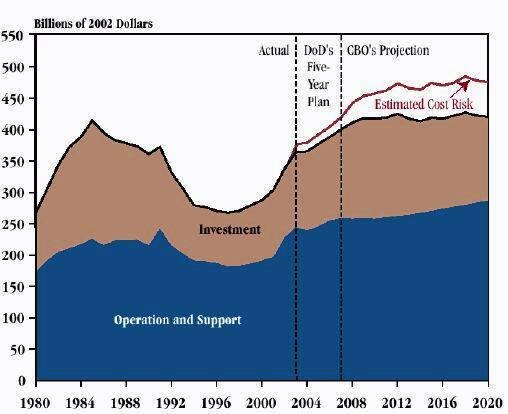
The DPP is a useful, if somewhat dippy document. The figure below is a copy of a chart depicting the CBO DPP budget totals out to 2017 [it is taken from Atch 1 (718KB PDF). Note how the defense budget is projected to continue rising beyond 2007, note also that CBO suggests it could rise further than predicted, because of "cost risk." Now note the charts in the CBO report on pages xviii and xix) -- remember, this is the Pentagon's data -- that show how that the average age of our weapons will continue to get older during the FYDP time horizon (actually until about 2010), assuming Congress appropriates the huge budget increases President Bush wants. Note finally, how that average age will not show any real improvements until the far never-never land of the DPP.
The cost risk and the continued aging of our weapons give a hint of the long-term budget pressures being pumped merrily into the body politic by courtiers of Versailles, but like like the GOSPLAN of the old Soviet Union, the FYDP/DPP data in Pentagon or the CBO report say little about what actual pressures are being pumped into system or what the future meltdown will really look like
One reason is that the CBO, like the Pentagon, is only concerned about the upside cost and budget risk. CBO and the Dipsters in the Pentagon understate the real risk because they ignore the extent to which the budget numbers in the outyears of the FYDP have been totally corrupted by the Defense Power Games (Front Loading and Political Engineering) for years.
For an explanation of how these power games corrupt budget plans and of what the long term consequences are, I refer you to the first half of Atch 2 (149KB PDF), as well as
And further information which can be found at -
Lets take a quick look at how this corruption manifests itself at the macroscopic level in the real world.
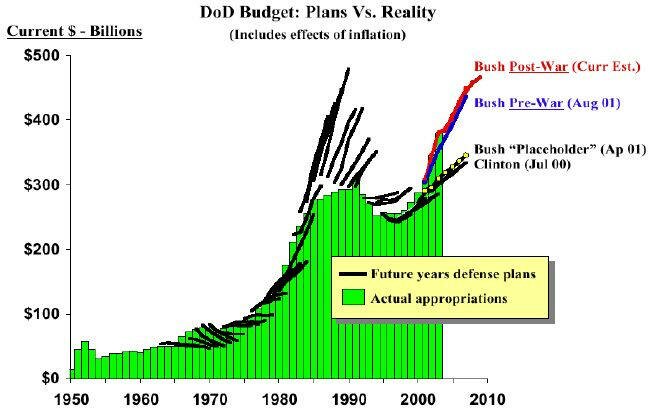
The figure below compares budget predictions of all the FYDPs produced by the Pentagon since they started in 1962 (the lines) to actual budgets appropriated by Congress (the bars). By necessity, the effects of inflation are included, whereas the data in the CBO chart has inflation removed. Bear in mind, it is impossible to remove inflation for about a third of historical FYDPs for reasons explained in my statement to Congress -- i.e, http://www.d-n- i.net/fcs/spinney_testimony_060402.htm -- but it makes no difference in terms of the mismatch, because we are comparing the same years to each other. Moreover, planners have to forecast inflation when they look into the future, so inflation predictions should be considered part of the plan. Now imagine how the budget totals in the current DPP would extend the Red line out 2017, and then what the extent of the mismatch could be by 2017. Of course, you can not possibly have a clue to size of the eventual mismatch -- that is the point!
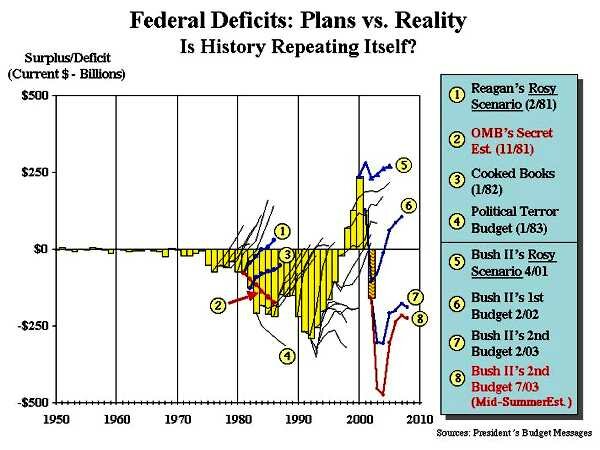
With this back ground in mind, it is important to understand that the chaos produced by the Pentagon's central planners is only the tip of a much larger national iceberg. The nation's central planners (in OMB) are playing the same game and thereby helping to produce a ballooning national debt bomb which will explode at the same time the defense budget bomb explodes and retirement of the baby boomers blows up the Medicare and Social Security budgets. The magnitude of the chaos produced in Washington can be seen in the ballooning mismatch between predicted deficits and actual deficits -- Are we now on the cusp of a disaster like that which occurred in the early 1980s? No one knows this either, including the people predicting the rapid improvement in the deficit.
The second half of Atch 2 (149KB PDF) shows how this deficit mess is helping to fuel the rapidly growing national debt bomb.
That is enough for now, I will have more to say on these subjects in the future.
Chuck Spinney
[Disclaimer: In accordance with 17 U.S.C. 107, this material is distributed without profit or payment to those who have expressed a prior interest in receiving this information for non-profit research and educational purposes only.]
Defense Economics and Acquisition Reform
|